
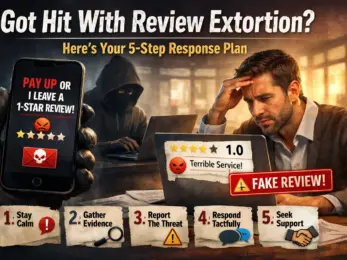
You wake up to 15 one-star reviews on your Google Business Profile. All posted within 24 hours. All vague, generic complaints that don't match any actual customer experience you've had.
Then your phone buzzes. WhatsApp message from an unknown number: "Hi, I can help remove those bad reviews for $500."
Welcome to review extortion. It's happening more often than you'd think, and it's designed to panic you into paying up fast.
Here's what you need to know: Paying them won't help. It just puts a target on your back for round two.
Instead, follow this five-step plan. It's based on what actually works when dealing with these scams.
STEP 1: DO NOT ENGAGE OR PAY
This is the hardest part when you're watching your rating tank in real-time. But it's the most important.
Do not:
- Reply to the scammer's messages
- Offer any money, discounts, or free services
- Try to negotiate or reason with them
- Click any links they send you
Here's why: Paying doesn't guarantee the reviews come down. Google controls review removal, not some random person on WhatsApp. And once scammers know you'll pay, they'll either come back for more or sell your business info to other extortionists.
Think of it like dealing with a kidnapper who has no hostage. They're banking on you panicking before you realize they have zero power.
The fake reviews hurt, no question. But handing over cash (or worse, your payment info) to criminals hurts more.

STEP 2: GATHER ALL EVIDENCE IMMEDIATELY
As soon as you spot the pattern, start collecting proof. You'll need this for Google and potentially law enforcement.
Screenshot everything:
- Every single suspicious review (full text, date, reviewer name)
- All messages from the extortionist (WhatsApp, email, DMs, text)
- Make sure timestamps and contact details are visible
- Any threats, demands, or "offers to help"
- The sudden spike in your review timeline
Pro tip: Take screenshots on your phone, then back them up to your computer or cloud storage immediately. Don't just rely on your phone in case something happens to it.
The pattern Google looks for is obvious once you document it:
- Multiple 1-star reviews in a short window (usually 15+ within 24 hours)
- Generic complaints that don't mention specific services or experiences
- Reviews from accounts with little to no other activity
- Contact from someone offering to "fix" the problem for money
The more evidence you have, the faster Google can act.
STEP 3: DESIGNATE A HANDLER AND LIMIT INTERNAL COMMUNICATION
If you have employees or business partners, pick one person to manage this situation. Ideally someone who won't get emotional or make rash decisions under pressure.
Why this matters:
If the extortionist is still trying to contact you, having multiple people respond creates confusion. One employee might ignore them while another tries to negotiate. That inconsistency makes you look desperate and gives scammers more intel.
Your designated handler should:
- Be the only person communicating about the extortion (if communication is unavoidable)
- Keep detailed notes of every interaction
- Not make any promises or commitments
- Report updates to the team without sharing sensitive details publicly
Important: Don't post about the extortion on social media while it's happening. That can tip off the scammers that you're taking action, and they might escalate or disappear before Google investigates.
STEP 4: REPORT TO GOOGLE USING THE OFFICIAL CHANNEL
Google has a specific form for reporting review extortion. Use it.
Search for "Google merchant extortion report form" or contact Google Business Profile support and ask for the extortion reporting process.
What you'll need to submit:
- Your contact information and relationship to the business
- Your business name, address, and Google Business Profile link
- Details about each suspicious review (dates, content, reviewer names)
- All communication from the third party (your screenshots from Step 2)
- Explanation of how they contacted you and what they demanded
Be thorough but factual. Don't editorialize or vent, just present the evidence clearly.
Timeline expectations: Google doesn't publish response times, but reports with solid evidence typically see action within a few days to two weeks. The suspicious reviews may be removed if Google confirms they violate policies.
Keep in mind: Google removes reviews that violate their guidelines, not reviews that are simply negative. But extortion-related fake reviews almost always violate multiple policies (fake engagement, conflicts of interest, impersonation).
STEP 5: RESPOND PROFESSIONALLY TO REVIEWS THAT REMAIN
While you wait for Google to investigate, some of those fake reviews will still be visible. Here's how to handle them without making things worse.
Write a brief, professional owner response to each one:
"We have no record of serving a customer matching this description. If you were a genuine customer, please contact us directly at [phone/email] so we can locate your transaction and address your concerns. We take all feedback seriously and want to make things right for real customers."
What this does:
- Signals to other customers that you're aware something's off
- Shows you're responsive without admitting fault
- Creates a public record that you suspect fraud
- Doesn't engage with the extortionist directly
What NOT to say:
- "This is a fake review from a scammer"
- "Someone is extorting us"
- "We're reporting this to Google"
- Anything angry, defensive, or overly detailed
Keep it calm and professional. Your real customers will read between the lines.
WHAT HAPPENS NEXT
Once you've reported the extortion and documented everything, the hardest part is waiting.
In the meantime:
- Don't change your review request process. Keep asking real customers for reviews. New legitimate reviews help dilute the fake ones.
- Monitor your profile daily. If the extortionist tries again, you'll catch it faster.
- Consider filing a police report. Extortion is a crime. Even if law enforcement can't do much internationally, having a report on file creates a paper trail.
Most importantly: This situation is temporary. Your real reputation is built on years of actual customer experiences, not a one-day spam attack.
Google's systems are getting better at catching these patterns. The reviews will likely come down. And once they do, your rating will bounce back.
THE BIGGER PICTURE
Review extortion works because businesses panic. Scammers know your Google rating feels like life or death, so they manufacture an emergency and offer a "quick fix."
But here's the thing: Your business survived before Google reviews existed. A temporary rating drop from fake reviews doesn't erase your actual quality or customer relationships.
The best defense is knowing this playbook before it happens to you. Share it with other business owners in your network. The more people recognize the pattern, the less effective these scams become.
And if you're dealing with this right now? Follow the five steps. Don't pay. Document everything. Report it properly. You'll get through this.
If you want to set up a system that helps you collect reviews consistently from real customers: so your rating is more resilient when sketchy stuff happens: check out Brand Defender. We help businesses automate the review request process without the headaches.
But for now, focus on handling the extortion first. Everything else can wait.