
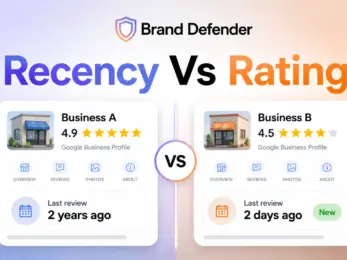
For years, the "holy grail" of local business was simple: get as many 5-star reviews as possible. If you had a 4.9 rating and your competitor had a 4.2, you won. End of story.
But as we move through 2026, the rules of the game have shifted. Google’s new Comparison View and AI-driven search results have introduced a new heavyweight champion into the ring: Recency.
Today, a 4.8-star rating from two years ago is a red flag, not a badge of honor. In fact, if your most recent review is older than 90 days, you might as well be invisible to nearly three-quarters of your potential customers.
In this guide, we’re breaking down the battle between Recency and Rating, how Google’s new interface chooses winners, and what your small business needs to do to stay on top.
THE RATING BASELINE: YOUR TICKET TO THE GAME
Before we talk about recency, we have to acknowledge that your overall rating still matters: but perhaps not in the way you think. In 2026, your star rating acts as a gatekeeper.
- The 4.0 Threshold: Statistics show that businesses with a 4.0 rating or higher appear approximately 58% more often in the Local Pack than those below the 4.0 mark. If you drop below a 4.0, Google’s algorithms (and users) start to filter you out of the "best" categories.
- The 4.5 "Sweet Spot": You might think a perfect 5.0 is the goal, but data suggests otherwise. Profiles with a 4.5-star rating actually convert about 12% better than those with a perfect 5.0. Why? Because consumers in 2026 are savvy; they find a perfect score suspicious and prefer to see a natural mix of feedback.
- The Trust Floor: About 49% of consumers won’t even consider a business that has less than a 4-star rating.
Think of your rating as your entry ticket. It gets you into the comparison, but it doesn't necessarily win you the customer.
RECENCY: THE 2026 TIEBREAKER
Once you’ve cleared the 4.0-star hurdle, the competition moves to Recency. This is where most small businesses: especially busy tradespeople and medical offices: start to lose ground.
Google’s 2026 ranking algorithm places a massive emphasis on "freshness." Recent reviews are treated as a signal that your business is active, relevant, and currently providing good service.
- The 3-Month Rule: A staggering 73% of consumers now say that reviews older than three months are effectively irrelevant. If your last "Great job!" was from last summer, a potential customer assumes something has changed: maybe you have new staff, higher prices, or lower standards.
- The 5x Impact: Local SEO data indicates that reviews from the last 30 days can have up to five times the ranking impact of reviews older than a year.
- The "Current Love" Signal: Google’s AI looks for a "steady stream." A business that gets 3 reviews every month ranks more consistently than a business that gets 50 reviews in one week and then nothing for six months.

UNDERSTANDING GOOGLE’S NEW "COMPARISON VIEW"
If you haven’t seen the 2026 "Comparison View" yet, it’s a game-changer for how people find dentists, restaurants, and plumbers. Instead of just a list of names, Google now presents a side-by-side breakdown, often powered by Gemini (Google’s AI).
In this view, the AI doesn't just look at the 4.7 stars. It reads your recent reviews and summarizes them for the user.
The AI Summary might say:
"Business A has a 4.9 rating, but customers haven't posted in 6 months. Business B has a 4.5 rating, with 12 new reviews this month praising their 'fast response time' and 'friendly front desk'."
Which one would you choose? Most customers are choosing Business B. The "Comparison View" prioritizes the narrative of the now over the glory of the past.
This is why understanding why Google's new AI search will change the way you get found is so critical for business owners today.
INDUSTRY SPOTLIGHT: WHO IS AT RISK?
Different industries feel the "Recency vs. Rating" battle in different ways.
1. MEDICAL & DENTAL OFFICES
For a dentist, a high rating is about trust and safety. However, patients are extremely sensitive to staff changes. If your reviews from 2024 say "The receptionist was wonderful," but you’ve replaced your entire front desk since then, those reviews are misleading. Patients look for reviews from the last 30 days to confirm the office vibe is still positive.
2. RESTAURANTS
Recency is everything in food. A restaurant that was great two years ago could have a new chef today. Google’s Comparison View for restaurants often highlights "Recent Mentions" of specific dishes. If you aren't getting a steady flow of new reviews, Google can't tell people that your current specials are worth the trip.
3. TRADESPEOPLE (PLUMBERS, ELECTRICIANS, HVAC)
For trades, the biggest factor is often responsiveness. A review from last week that says "They showed up on time and fixed the leak" is worth more than ten reviews from three years ago. In the Comparison View, Google often labels businesses with "Highly Responsive" based on the frequency and recency of reviews and fast review responses.

THE DANGER OF THE "REVIEW GAP"
Many small businesses fall into the trap of the "Review Gap." This happens when you run a big promotion or ask all your friends for reviews at once, get a big boost, and then stop asking.
Why the "Review Gap" is dangerous:
- Algorithmic Red Flags: Google's 2026 spam filters are highly sensitive to "bursts." A sudden spike of 30 reviews followed by zero for three months looks like manipulation.
- Loss of Momentum: When the flow stops, your "Review Velocity" drops. Google interprets this as a decline in business popularity, and you'll slowly start to slide down the Local Pack rankings.
- Vulnerability to Attacks: If you only have old reviews, a single new 1-star review will sit at the very top of your profile for months. You need a "shield" of fresh positive reviews to bury the occasional negative one. If you're facing a sudden influx of bad feedback, check out our guide on how to protect your profile instantly from a 1-star attack.
HOW BRAND DEFENDER KEEPS THE STREAM FLOWING
The reality for most small business owners is that you don't have time to manually text every customer and beg for a review. That’s where automation becomes your most valuable employee.
At Brand Defender, we designed our software to solve the "Recency" problem specifically for the 2026 landscape. We don't just help you get reviews; we help you manage the cadence.
- Automated Requests: Our system integrates with your workflow to send review requests at the perfect moment: right after a meal, a dental appointment, or a completed job.
- Steady Velocity: By automating the process, you ensure a "trickle" of reviews every single week, rather than a suspicious burst. This keeps you at the top of Google’s Comparison View.
- Social Promotion: When you get a great recent review, our software helps you instantly promote it on social media, doubling the value of that "fresh" feedback.
- AI-Powered Management: We help you respond to reviews quickly, which Google also tracks as a signal of an active, healthy business.

CONCLUSION: THE HYBRID WINNER
So, who wins the battle? Recency or Rating?
The answer is Consistency.
In 2026, you cannot rely on a high rating from the past to carry you through the future. Google’s Comparison View is designed to surface the businesses that are doing great work right now.
To win, you need to maintain a baseline of 4.5 stars while ensuring that your most recent review is never more than two weeks old. By focusing on review velocity, you satisfy both the human customer looking for current proof and the Google algorithm looking for active relevance.
Stop living off your 2024 reputation. Start building the one you need for today.