
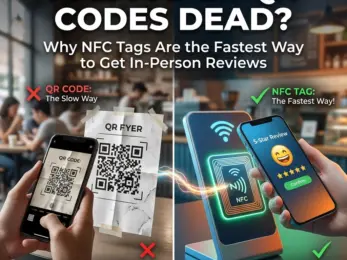
If you’ve walked into a restaurant or a local shop in the last few years, you’ve seen them. Those pixelated black-and-white squares are taped to windows, printed on menus, and stuck to checkout counters. For a long time, the QR code was the undisputed king of contactless interaction. It saved us during the pandemic and gave businesses a simple way to point customers to their Google profiles.
But as we move through 2026, the digital landscape is shifting. Customers are experiencing "QR fatigue," and business owners are finding that paper codes aren't as reliable as they used to be. Enter NFC (Near Field Communication) tags.
While they aren't brand new, their application for local business reviews is becoming the gold standard. If you want to stay ahead of the curve and make it as easy as possible for your customers to leave feedback, it’s time to ask: Are those paper QR codes actually holding you back?
THE RISE AND FALL OF THE PAPER QR CODE
QR codes made a massive comeback because they were free to generate and cheap to print. Any business could go to a website, download a code, and stick it on a piece of paper. However, "cheap and easy" often comes with a hidden cost.
In a busy retail or service environment, paper doesn't hold up. It gets wet, the edges curl, and the ink fades under the sun. A faded QR code is a broken link. When a customer tries to scan a code that won't register, the "moment of intent": that split second where they were actually willing to leave you a review: disappears.
Furthermore, there is a growing security concern. It is incredibly easy for bad actors to print a sticker of a malicious QR code and place it directly over yours. This can lead customers to phishing sites, which not only hurts your reputation but can also get your business flagged by Google’s security filters. You can read more about this in our guide on why your in-store QR codes might be unsafe.
WHAT IS NFC AND WHY IS IT DIFFERENT?
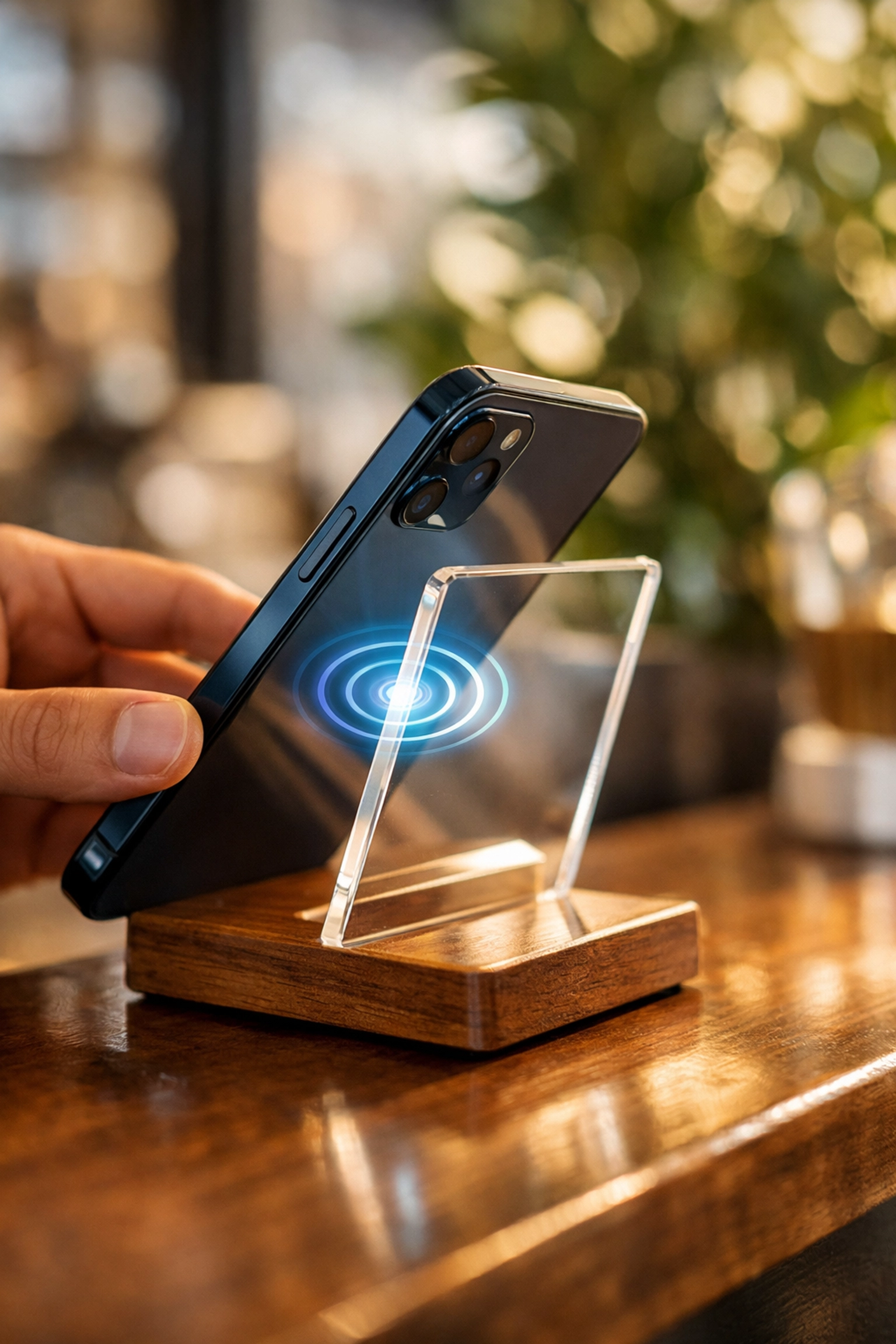
NFC stands for Near Field Communication. It’s the same technology that allows you to use Apple Pay or Google Wallet at a checkout terminal. Instead of opening a camera app and trying to focus on a square, a customer simply taps their phone against a small chip or "tag."
The benefits are immediate:
- Zero App Required: Customers don’t need to open their camera or a specific scanner app.
- Instant Trigger: The phone detects the signal and immediately opens the review link.
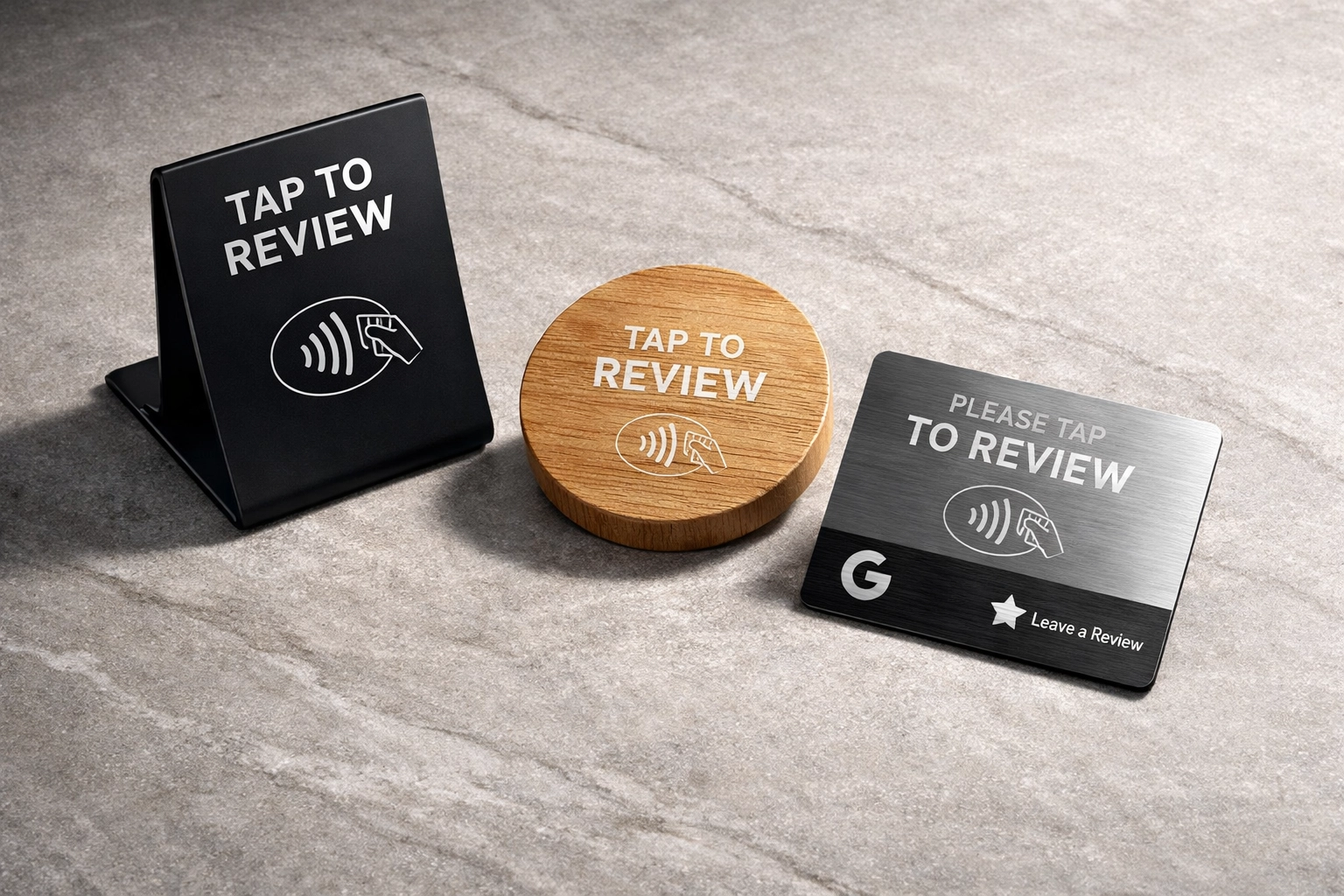
- High Durability: NFC chips are usually embedded in plastic, wood, or metal stands that last for years.
- Premium Feel: Tapping a sleek stand feels much more modern and professional than scanning a crinkled piece of paper.
WHY NFC IS THE FASTEST WAY TO GET REVIEWS IN 2026
Speed is the enemy of friction. Every extra step you ask a customer to take reduces the likelihood that they will finish the task.
The QR Code Workflow:
- Customer pulls out phone.
- Customer unlocks phone.
- Customer opens Camera app.
- Customer aligns the camera with the code.
- Customer waits for the focus and the link to pop up.
- Customer taps the link.
The NFC Workflow:
- Customer taps their phone against the tag (often even if the phone is locked).
- The review page opens.
By removing those middle three steps, you increase your conversion rate. In a world where review freshness is more important than ever, these small gains in speed lead to a significantly higher volume of reviews over time.
ALIGNING WITH GOOGLE’S 2026 POLICY UPDATES
Google has become much stricter about how reviews are collected. Their AI models are now trained to detect "unnatural" review patterns. If you have a sudden burst of 50 reviews in one day followed by months of silence, it looks suspicious.
Google’s 2026 updates prioritize a steady, natural flow of feedback. They want to see that customers are leaving reviews while they are actually at your place of business. NFC tags facilitate this perfectly. Because they are physical objects located at your point of sale, they encourage real-time, authentic engagement.
If you're still using old-school tactics like "review gating" (screening for 5 stars before sending them to Google), you're at risk of being penalized. You can check out the full breakdown of why Google’s 2026 update changes everything to ensure your methods remain compliant.
DURABILITY AND THE "PROFESSIONAL" ADVANTAGE
Think about the impression a paper QR code leaves. If it’s taped to a counter with yellowing Scotch tape, it sends a message about your brand’s attention to detail.
NFC tags are typically housed in professional-grade materials. At Brand Defender, we often recommend using high-quality stands or "tap-to-review" cards. These are:
- Waterproof: Perfect for restaurants, bars, and outdoor service areas.
- Tamper-proof: Unlike a QR code, an NFC chip's destination URL is locked inside the chip. A scammer can't simply "write over" it without a specialized tool.
- Portable: For service pros like plumbers or painters, an NFC card can be kept on a keychain or in a wallet. You can get a review before you even leave the driveway.

THE "SCAN VS. TAP" DEBATE: WHICH IS BETTER?
While NFC is superior in terms of speed and durability, you don't necessarily have to choose one or the other. Many modern review stands feature both an NFC chip and a printed QR code.
Why use both?
- Accessibility: Most phones made after 2018 have NFC capabilities, but some older models or budget devices might still rely on the camera.
- Education: Some customers might not know what "Tap to Review" means yet. Having the QR code as a visual backup ensures no one is left out.
- Redundancy: If one method fails (e.g., the customer's camera lens is dirty), they have an alternative.
However, the trend is clear: as more people become accustomed to "Tap to Pay," they are naturally gravitating toward "Tap to Review." It is the path of least resistance.
REDUCING THE RISK OF "REVIEW ATTACKS" AND DISAPPEARING REVIEWS
One of the biggest frustrations for business owners in 2026 is seeing legitimate reviews disappear. Google’s AI is constantly cleaning up "spam," and sometimes it gets overzealous.
When a review is triggered by an NFC tap, Google receives metadata that confirms the user was physically present at your location. This "proximity signal" is a powerful way to prove to Google that the review is authentic. Reviews generated through physical taps are much less likely to be flagged as "fake" compared to reviews generated by links sent via email days later.
If you are currently struggling with reviews that keep disappearing or 1-star review attacks, switching to a physical, in-person collection method like NFC is one of the best defensive moves you can make.
HOW TO GET STARTED WITH NFC
Transitioning from paper to NFC doesn't have to be complicated. Here is a simple checklist for making the switch:
- Audit your current "Review Points": Where do you currently ask for feedback? The checkout? The dining table? The waiting room?
- Choose your hardware: Decide between adhesive tags (great for tables), acrylic stands (perfect for counters), or portable cards (ideal for mobile workers).
- Optimize your destination: Don’t just send them to your homepage. Send them directly to the "Write a Review" pop-up on your Google Business Profile.
- Train your staff: The hardware is only half the battle. Your team needs to know how to say, "If you had a great experience, just tap your phone right here!"
- Monitor the results: Watch your "review velocity." You should aim for 3-5 reviews every month to keep your profile active in Google’s eyes.
THE BOTTOM LINE
Are paper QR codes dead? Not quite: they still serve as a useful backup. But as a primary strategy for growing your business reputation, they are quickly becoming obsolete.
NFC technology offers a faster, safer, and more professional way to connect with your customers. In an era where Google’s AI is reading your business profile and judging your "activity" every single day, you cannot afford to have a review process that is slow or prone to failure.
By moving toward a "Tap to Review" model, you’re not just following a trend; you’re building a frictionless system that respects your customer’s time and protects your hard-earned reputation.
Ready to modernize your review strategy?
At Brand Defender, we specialize in helping businesses navigate these technical shifts so you can focus on what you do best. Check out our other resources to learn more about keeping your Google profile at the top of the search results.