
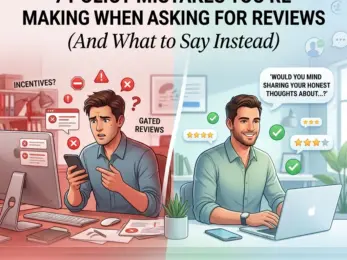
Asking for reviews used to be simple. You’d finish a job, shake the customer's hand, and ask them to "leave us five stars on Google." But as we move through 2026, the rules of engagement have changed drastically. Google’s AI is now more sophisticated than ever at spotting manipulation, and the Federal Trade Commission (FTC) has tightened its grip on how businesses solicit feedback.
If you are still using the same review-requesting tactics from three years ago, you might not just be wasting your time, you could be actively hurting your ranking or even facing a permanent ban from search platforms.
Here are the seven most common policy mistakes businesses make today and exactly what you should say instead to stay safe and boost your reputation.
1. REVIEW GATING: THE "FILTER" THAT GETS YOU FLAGGED
Review gating is the practice of sending customers a preliminary question like, "Did you have a good experience? Yes or No." If they click "Yes," they are sent to Google. If they click "No," they are sent to a private feedback form.
While it sounds like a smart way to protect your reputation, it is a major violation of Google’s terms of service and FTC guidelines. In 2026, transparency is king. Platforms want to see the full picture of a business, not just a curated highlight reel. If Google’s algorithms detect that you are only sending happy customers to their site, they may remove all your reviews, even the legitimate ones.
What to Say Instead:
Stop trying to hide the "No" and start embracing honest feedback. You want to ask for a review from every customer, regardless of their experience.
The Script: "Thank you for choosing us! We’re constantly looking to improve. Could you share your honest experience with us on Google? Whether it was a 5-star visit or we have room to grow, we value your feedback."
For a deeper dive into why this matters, check out our guide on is review gating actually bad.
2. THE BRIBERY TRAP: INCENTIVIZING POSITIVE FEEDBACK
We’ve all seen the signs: "Leave a 5-star review for a free coffee!" or "Show us your 5-star rating for $10 off your next bill." In 2026, this is a fast track to a policy violation.
The mistake here isn't necessarily the incentive itself, it's the requirement for the review to be positive. You cannot pay for stars. If you offer a discount or a gift card in exchange for a specifically "5-star" review, you are violating consumer protection laws.

What to Say Instead:
If you want to offer an incentive, it must be for the act of leaving a review, not the sentiment of the review.
The Script: "We’re running a monthly giveaway! Anyone who leaves a review of their recent experience, good or bad, is automatically entered to win a $50 gift card. Just let us know what you thought!"
Read more about the specifics of offering discounts for reviews to ensure you’re staying compliant.
3. THE "HEY YOU" PROBLEM: GENERIC, ROBOTIC REQUESTS
Generic requests like "Please leave us a review" are not only boring: they are ineffective. In 2026, Google’s AI Search prioritizes reviews that contain specific details about the service or product. A generic "Great service!" doesn't help your SEO nearly as much as a review that says, "John was great at fixing my leaky faucet in Brooklyn."
When you send a generic request, you get a generic response. Worse, bulk-sending the same message to hundreds of people at once can trigger spam filters.

What to Say Instead:
Personalize your requests. Mention the customer’s name and the specific service they received. This encourages them to be specific in their review, which helps Google understand what your business does.
The Script: "Hi [Name], it was a pleasure helping you with your [Service/Product] today! We’d love to hear your thoughts on how the process went. Small details help our team and other customers a lot!"
4. THE SELF-REVIEW TRAP (AND STAFF REVIEWS)
It’s tempting to have your employees leave a quick 5-star review to boost a new location or a slow month. However, Google’s conflict of interest policy is very clear: you cannot review your own business, and neither can your employees.
In 2026, IP tracking and account history analysis are highly advanced. If Google sees a review coming from an IP address associated with your business headquarters or a device that frequently logs into your Google Business Profile, it will likely be flagged and removed.
What to Say Instead:
Don't ask your team for reviews. Instead, ask your team to ask customers for reviews. Empower your staff to be the bridge between a great service and a great online rating.
The Internal Strategy: "Our goal this month is to hear from 20 customers. When you finish a project, remind the client that a quick review on Google helps our small business grow."
5. PLAYING DIRTY: REVIEWING THE COMPETITION
This should go without saying, but leaving fake negative reviews for your competitors is a major violation that can lead to legal action and platform bans. Google’s 2026 AI is specifically designed to detect "coordinated inauthentic behavior." If it sees a pattern of accounts leaving 5 stars for you and 1 star for your neighbor, both businesses will likely be penalized.
What to Say Instead:
Focus on your own yard. The best way to beat the competition is to have a review profile that is more active, more detailed, and more recent than theirs.
Focus on your Google star rating by providing a superior customer experience that naturally generates positive buzz.

6. REVIEW FATIGUE: PESTERING AND POOR TIMING
Sending five follow-up emails asking for a review is the fastest way to turn a happy customer into an annoyed one. "Review fatigue" is real. If you ask too often, or at the wrong time, customers are more likely to leave a 1-star review just to get you to stop.
Additionally, Google looks at "Review Velocity": the speed at which you get reviews. If you suddenly get 50 reviews in one day after months of silence, it looks suspicious.
What to Say Instead:
Timing is everything. Ask once, shortly after the service is completed, and perhaps one gentle reminder a few days later.
The Script: "Hi [Name], we hope you're enjoying your [Product]! If you have a spare 30 seconds, we’d love to hear your feedback. If not, no worries at all: we’re just glad to have you as a customer!"
To streamline this without being annoying, you can use SMS hacks to reach customers where they are most comfortable.
7. HIGH FRICTION: MAKING THE PROCESS TOO HARD
If a customer has to search for your business, click three different buttons, and log into a secondary account just to leave a review, they won’t do it. High friction leads to low conversion.
Many businesses make the mistake of using complicated URLs or directing people to their website first. Every extra click reduces your chances of getting that review by about 50%.

What to Say Instead:
Provide a direct, "one-tap" link to your Google review page. In 2026, most customers are on mobile, so make sure the link opens directly in the Google Maps app or a mobile browser.
The Script: "We’d love to hear your thoughts! You can leave a quick review right here: [Direct Link]. It only takes a second!"
HOW TO MANAGE YOUR REPUTATION IN 2026
The landscape of online reviews is shifting toward quality and authenticity. Google’s updates mean that "gaming the system" is no longer a viable long-term strategy. To thrive, you need a system that facilitates genuine feedback while staying strictly within policy boundaries.
At Brand Defender, we specialize in helping businesses navigate these complex rules. Whether you are looking for a Starter Plan to get the basics right or a Pro Plan for advanced reputation management, we provide the tools to help you grow safely.
SUMMARY OF THE "WHAT TO SAY" CHEAT SHEET:
- Instead of Gating: "We value all feedback, good or bad."
- Instead of Bribery: "Every reviewer is entered into our monthly drawing."
- Instead of Generic: "How was your [Specific Service] with [Staff Name] today?"
- Instead of Friction: "Here is a one-tap link to share your thoughts."
By following these simple shifts in language and strategy, you can build a resilient, high-ranking brand that customers trust: and that Google loves. For more updates on the latest changes, keep an eye on Google’s 2026 policy updates.