
Walk into almost any local business today: a coffee shop, a dental office, or a boutique: and you’ll likely see a small plastic stand with a QR code. It usually says something like, "Love us? Scan to leave a review!"
For years, this was the gold standard for gathering customer feedback. It was quick, easy, and caught the customer while they were still in the building. However, as we move through 2026, the landscape of Google’s local search algorithm has changed drastically. What used to be a "best practice" is now becoming a major red flag for Google’s advanced AI filters.
If you’ve noticed that your hard-earned reviews aren't showing up, or if your star rating has suddenly dipped because legit reviews were removed, your in-store QR codes might be the culprit.

THE RISE OF THE GOOGLE REVIEW FILTER
Google has a massive problem: fake reviews. To combat this, they’ve deployed sophisticated AI systems designed to spot patterns that look "unnatural." While your business is likely legitimate and your customers are real, the way you collect reviews might look exactly like the tactics used by "click farms" or review-manipulation services.
When a customer scans a code in your shop and leaves a review immediately, they are creating a data trail. If that trail looks too similar to other reviews coming from your business, Google’s "spam" alarm goes off.
Here are five specific reasons why your in-store QR codes are putting your Google Business Profile at risk.
1. THE IP CLUSTERING TRAP (THE WI-FI PROBLEM)
The most common reason in-store reviews get flagged is "IP clustering." When a customer visits your business, they often connect to your guest Wi-Fi.
When that customer scans your QR code and submits a review while connected to your network, Google sees the review coming from your store’s IP address. If ten different customers leave reviews throughout the day using your Wi-Fi, Google sees ten different people sharing one single digital "address."
To Google’s AI, this looks like the business owner is sitting in the back office, logging into different accounts, and writing fake reviews for themselves. Even if those customers are on their own mobile data (5G/6G), being in the exact same physical proximity while submitting reviews can trigger these filters.
2. DEVICE FINGERPRINTING AND "REVIEW STATIONS"
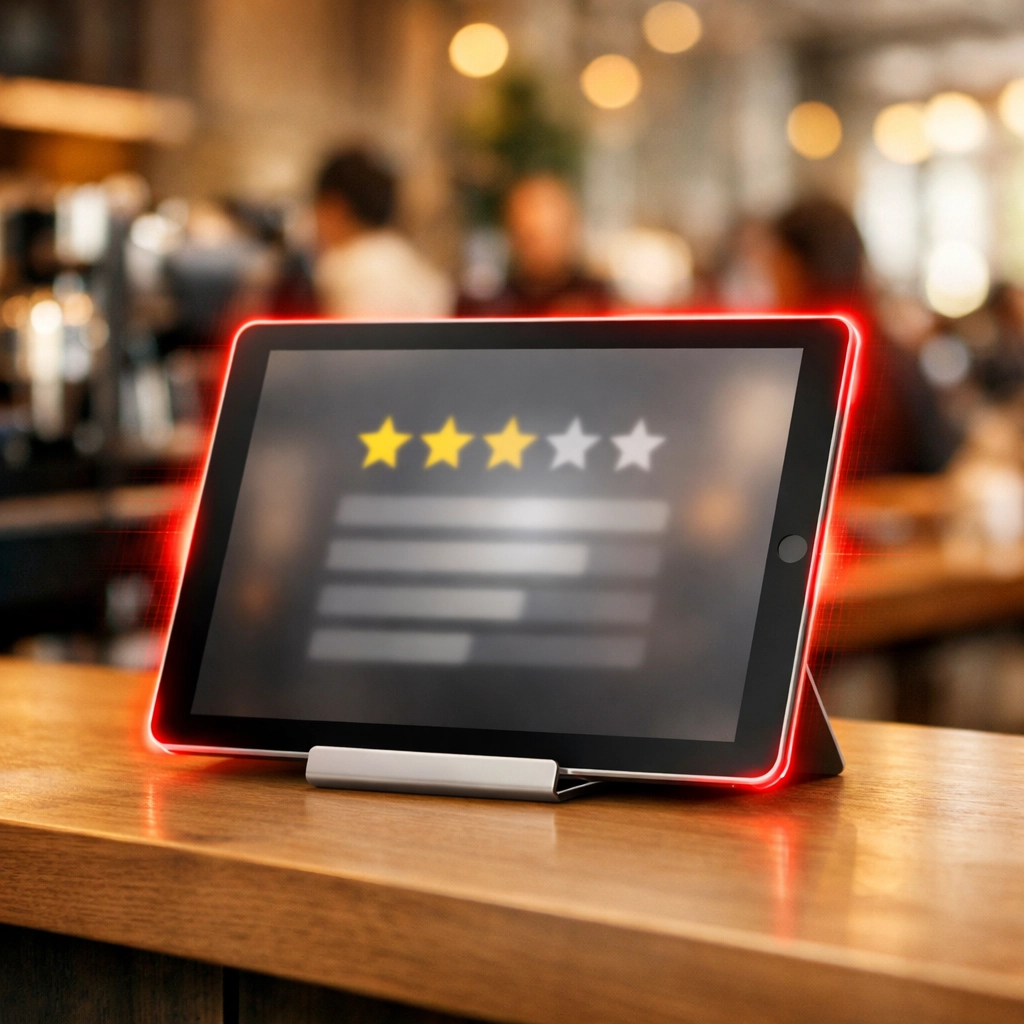
Some businesses take the QR code concept a step further by setting up a "Review Station": an iPad or tablet fixed to a counter where customers can log in and leave a rating.
This is a direct violation of Google’s terms of service.
Google uses "device fingerprinting" to identify the specific hardware used to post a review. If Google sees 50 reviews coming from the exact same iPad hardware ID, it will almost certainly flag those reviews as fraudulent. Google wants reviews to be independent and unbiased. A dedicated device provided by the merchant is seen as "on-site pressure," which leads to biased results.
Even if you aren't using a shared tablet, having everyone scan the same physical code in the same spot every day creates a pattern that is too consistent for Google’s liking. They prefer a diverse range of entry points for reviews.
3. THE "VELOCITY SPIKE" PHENOMENON
In-store QR codes often lead to "Review Velocity Spikes." Imagine a busy Saturday where your staff is highly motivated and asks every single person to scan the code. You might get 15 reviews in six hours. Then, from Monday to Thursday, when the staff is less proactive, you get zero reviews.
Google’s AI looks for consistency. A sudden burst of activity followed by total silence is a classic sign of a "review attack" or a temporary incentive program (which is also against the rules).
Instead of chasing 50 reviews in one weekend, it is much better to have a steady stream of feedback. As we’ve noted in our guide on why you need 3-5 reviews every month instead of 50 once a year, consistency is the secret to local ranking in 2026.
4. GEOLOCATION AND PHYSICAL PROXIMITY
Google knows exactly where your customers are. When someone scans a QR code, Google has access to their GPS data. If 100% of your reviews are written while the customer is physically standing inside your four walls, it looks suspicious.
Google’s research shows that most "natural" reviews happen after the consumer has had time to reflect on the service: usually once they get home or back to the office. By forcing the review process to happen during the transaction, you are creating a data footprint that looks "forced."
Google's AI is reading your business profile and your customers' movements simultaneously. If the "Review Event" always happens at the "Business Location," the AI may decide those reviews are less trustworthy than a review written two hours later from a different zip code. You can learn more about how this works in our article on how Google's AI is reading your profile right now.
5. ON-SITE PRESSURE AND POLICY UPDATES
In 2026, Google and the FTC have become much stricter about "Review Gating" and "On-Site Pressure." Review gating is the practice of asking a customer if they had a good experience before sending them to Google. If they say "bad," you send them to a private form. If they say "good," you send them to Google.
Physical QR codes are often part of this "gated" ecosystem. Furthermore, having a staff member stand over a customer while they scan a code is considered "coerced" feedback. Google’s updated 2026 algorithms are specifically designed to detect and de-prioritize reviews that appear to be the result of in-person solicitation at the point of sale.
If you're worried about whether your current strategy falls into this trap, check out our breakdown on whether review gating is actually bad in 2026.

THE SAFER ALTERNATIVE: POST-VISIT AUTOMATION
If in-store QR codes are becoming risky, how should a local business get reviews? The answer lies in automation that mimics natural human behavior.
At Brand Defender, we advise businesses to move away from "The Ask" at the counter and toward a "Post-Visit Follow-up." Here is why this is safer and more effective:
- Diverse IP Addresses: When a customer receives a text or email an hour after they leave, they are usually on their home Wi-Fi or mobile data. This avoids the "IP Clustering" trap.
- Natural Timing: Reviews that arrive a few hours or a day after a visit look much more authentic to Google's filters.
- Better Content: Customers who write reviews from the comfort of their own home tend to write longer, more detailed descriptions. Detailed reviews are a massive ranking factor in 2026.
- Reduced Pressure: By sending a link via SMS, the customer doesn't feel pressured by a staff member watching them. This leads to more honest (and therefore more compliant) feedback.
For businesses like plumbers, painters, or home services, this is even more critical. You should focus on getting a review before you even leave the driveway through a digital request rather than a physical sticker.

HOW BRAND DEFENDER PROTECTS YOUR REPUTATION
Brand Defender was built to handle the complexities of these 2026 algorithm shifts. Our software doesn't just "ask for reviews": it manages the entire reputation lifecycle in a way that Google trusts.
- Automated SMS/Email Requests: We sync with your Point of Sale (POS) or CRM system to send a friendly request after the customer leaves.
- Smart Timing: We don't blast all your customers at once. We stagger requests to ensure a steady "velocity" that keeps Google's AI happy.
- Spam Protection: Our system monitors for "review attacks" or suspicious patterns. If we see a sudden influx of 1-star reviews, we help you activate a 5-step response plan immediately.
- Compliance First: We stay up to date with the latest Google and FTC rules so you don't have to. You can focus on running your business while we handle the digital defense.
SUMMARY: IS IT TIME TO DITCH THE QR CODE?
You don’t necessarily have to throw away every QR code in your store, but you should stop relying on them as your primary source of reviews. Use them for menus, for joining a mailing list, or for following your social media.
When it comes to Google reviews, the "In-Store Scan" is becoming too risky for the modern business owner. The "shadow-banning" of reviews is a real problem, and it's often caused by these small technical footprints that we don't think about.
If you’ve been wondering why your legit Google reviews keep disappearing, the QR code on your front desk might be the first thing to investigate.
Protect your profile, stay compliant, and start building a reputation that actually sticks.