
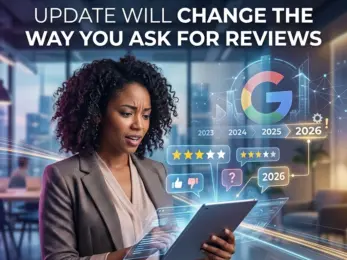
If you’re running a small business in 2026: whether you’re fixing leaky pipes, filling cavities, or serving up the best pasta in town: you already know that Google reviews are your lifeblood. They are the digital version of a "word-of-mouth" recommendation, and for years, the strategy was simple: get as many five-star reviews as possible, by any means necessary.
But as of April 2026, the rules of the game have completely changed.
Google has rolled out a massive policy update that fundamentally alters how businesses can ask for feedback. If you’re still using the "old" ways of gathering reviews, you might find your hard-earned reputation disappearing overnight. At Brand Defender, we’ve seen thousands of legitimate reviews get wiped out because business owners didn’t realize they were breaking the new AI-enforced rules.
Let’s break down what’s happening and how you can protect your business.
THE END OF "REVIEW GATING"
For a long time, many businesses used a tactic called "review gating." It worked like this: you’d send a private message to a customer asking, "How did we do? Rate us 1–5 stars." If they picked 1 or 2, you’d send them to a private contact form. If they picked 5, you’d send them the link to your Google Profile.
In 2026, Google has made it very clear: This is now strictly prohibited.
Google’s AI is now smart enough to detect when a business is "selectively soliciting" positive feedback. They want to see the good, the bad, and the ugly. If your profile only shows a stream of perfect 5-star reviews with zero constructive criticism, Google’s sentiment manipulation flags might go off. This can lead to your new reviews being frozen for 30 to 90 days while they "investigate" your profile.
You can learn more about why this practice is risky in our detailed guide on whether review gating is actually bad in 2026.

NO MORE BRIBING FOR 5 STARS
We’ve all seen it: "Leave us a review and get a free appetizer!" or "Review us for 10% off your next dental cleaning!"
While incentivizing reviews has technically been against the rules for a while, 2026 is the year Google actually started enforcing it with an iron fist. Their AI can now scan review text for keywords that suggest a reward was involved. Even worse, if a customer mentions the discount in their review (e.g., "Great service, thanks for the free coffee!"), that review: and potentially dozens of others: will be flagged and removed.
The policy is simple: you cannot offer discounts, free goods, or cash in exchange for a review. Period. It’s not just about being "honest"; it’s about avoiding the AI filters that are reading your business profile right now.
THE GOOGLE AI POLICE ARE WATCHING
Google’s 2026 AI is significantly more aggressive than previous versions. It doesn’t just look at what people write; it looks at how and when they write it.
Here are a few things that now trigger the "Fake Review" alarm:
- Unusual Spikes: If a local plumber usually gets two reviews a month but suddenly gets twenty in two days, the AI marks it as suspicious.
- Location Data: If a review comes from someone who hasn't actually been to your physical location (tracked via their phone's GPS), Google may flag it as fake.
- Template Language: If multiple reviews use the exact same phrasing, the AI assumes they were forced or written by the business owner.
REAL-WORLD EXAMPLES: DENTISTS AND TRADESPEOPLE
Let’s look at how this impacts specific industries.
For Dentists: The "In-Chair" Pressure
In the past, many dental offices would hand a tablet to a patient while they were still in the chair or at the checkout desk. Google’s 2026 policy explicitly states that merchants should not "require or pressure users to leave reviews while on the premises."
If Google sees a dozen reviews all posted from the same IP address (your office Wi-Fi) within a short window, they will likely delete them. It looks forced. Instead, it’s better to send a follow-up text a few hours after the appointment. This feels more natural and gives the patient time to actually experience the results of their visit.
For Tradespeople (Plumbers, Electricians, HVAC): The "Driveway" Strategy
If you’re a tradesman, getting a review before you leave the driveway is still a great goal, but the way you ask matters. You shouldn’t stand over the customer while they type.
A better approach is to have an automated system that sends a "Thank You" SMS as you’re packing up your tools. It’s professional, non-intrusive, and it provides a paper trail that looks organic to Google's AI. We’ve put together some SMS hacks for more reviews that work perfectly with these new rules.
WHY VELOCITY MATTERS MORE THAN VOLUME
One of the biggest secrets of the 2026 update is that Google no longer cares if you have 500 reviews if they’re all from three years ago. They are looking for Review Velocity: a steady, consistent stream of feedback.
Getting 50 reviews in one month and then zero for the rest of the year looks like a marketing "push" or a "review attack." Google prefers to see 3 to 5 reviews every single month. This shows that your business is consistently active and consistently providing good service.
If you’re struggling to keep that steady pace, check out why you need 3-5 reviews every month rather than a massive burst once a year.

HOW BRAND DEFENDER NAVIGATES THE 2026 UPDATE
At Brand Defender, we built our software to stay ahead of these changes. We don’t believe in "gaming the system" because, in 2026, the system is too smart to be gamed. Instead, we focus on Natural Automation.
- Drip Campaigns: Our software doesn't blast all your customers at once. It spaces out requests to ensure a natural "velocity" that keeps Google's AI happy.
- Multi-Channel Requests: We use a mix of Email and SMS, which mimics how real humans communicate.
- Social Media Integration: When you do get those glowing 5-star reviews, Brand Defender automatically turns them into beautiful social media posts for Facebook and Instagram. This doesn't just help your reputation; it drives traffic back to your site without relying solely on Google Search.
- The "Human" Factor: We help you respond to reviews in a way that doesn't look like a copy-paste disaster. Google’s AI also tracks how you respond to customers, and recycling your responses can actually hurt your ranking.
THE POSITIVE SIDE OF THE 2026 UPDATE
While these new rules might seem scary, they are actually good news for honest small business owners. Why? Because it’s becoming much harder for your competitors to "buy" their way to the top with fake reviews or incentivized spam.
When the "junk" reviews are cleared away, businesses that actually provide great service and ask for feedback the right way will naturally rise to the top. Your Google Profile is essentially your new website: it's the first thing people see, and in 2026, it’s where the battle for customers is won or lost.
QUICK TIPS FOR COMPLIANCE IN 2026:
- Stop the Bribes: Immediately end any "Review for a Discount" programs.
- Go Digital, Not Physical: Don't ask people to use a kiosk or a shared tablet in your office. Send a link to their personal phone instead.
- Be Consistent: Aim for a few reviews every week rather than a big bunch once a month.
- Be Real: Don’t worry about a 4-star review here and there. A profile with 100% 5-star reviews often looks "fake" to the new AI filters.
- Automate Safely: Use a tool like Brand Defender to handle the timing and delivery of your requests so you don't have to worry about the technicalities of the policy updates.
The landscape of local search is changing fast, but your goal remains the same: provide an excellent experience and make it easy for your happy customers to tell the world about it.
If you want to make sure your business is staying on the right side of Google's new AI, let’s get your review strategy automated and protected.